Blue Ocean Strategy
Blue Ocean Strategy by W. Chan Kim and Renée Mauborgne is the fastest way I know to build a Big Idea: a value curve unlike any competitor’s that still meets what customers want. It gets you out of the bloody red ocean of commoditized competition.
The question it answers
What should we eliminate, reduce, raise or create so we stop competing head to head?
Use it when
Prospects compare you on price because your offer looks like everyone else’s.
Your market feels saturated and every competitor is chasing the same buyers.
You need a differentiator worth testing before you spend more on marketing.
It’s the wrong tool when
Your market is so new that nobody agrees yet on what buyers compare. Talk to buyers first and find out what they actually care about.
You’re betting on demand you can’t prove yet. This framework gives you ideas worth testing, not answers. Put each one in front of real prospects before you spend money on it.
You’re only deciding one feature or one price. You don’t need to rethink the whole offer for that.
Build a value curve
Kim and Mauborgne map the factors an industry competes on with a graph they call the Strategy Canvas. Look at the factors your competitors compete on, and also at the alternatives prospects choose instead of you. Alternative industries and markets are a consistent source of differentiators I’ve found for many businesses.
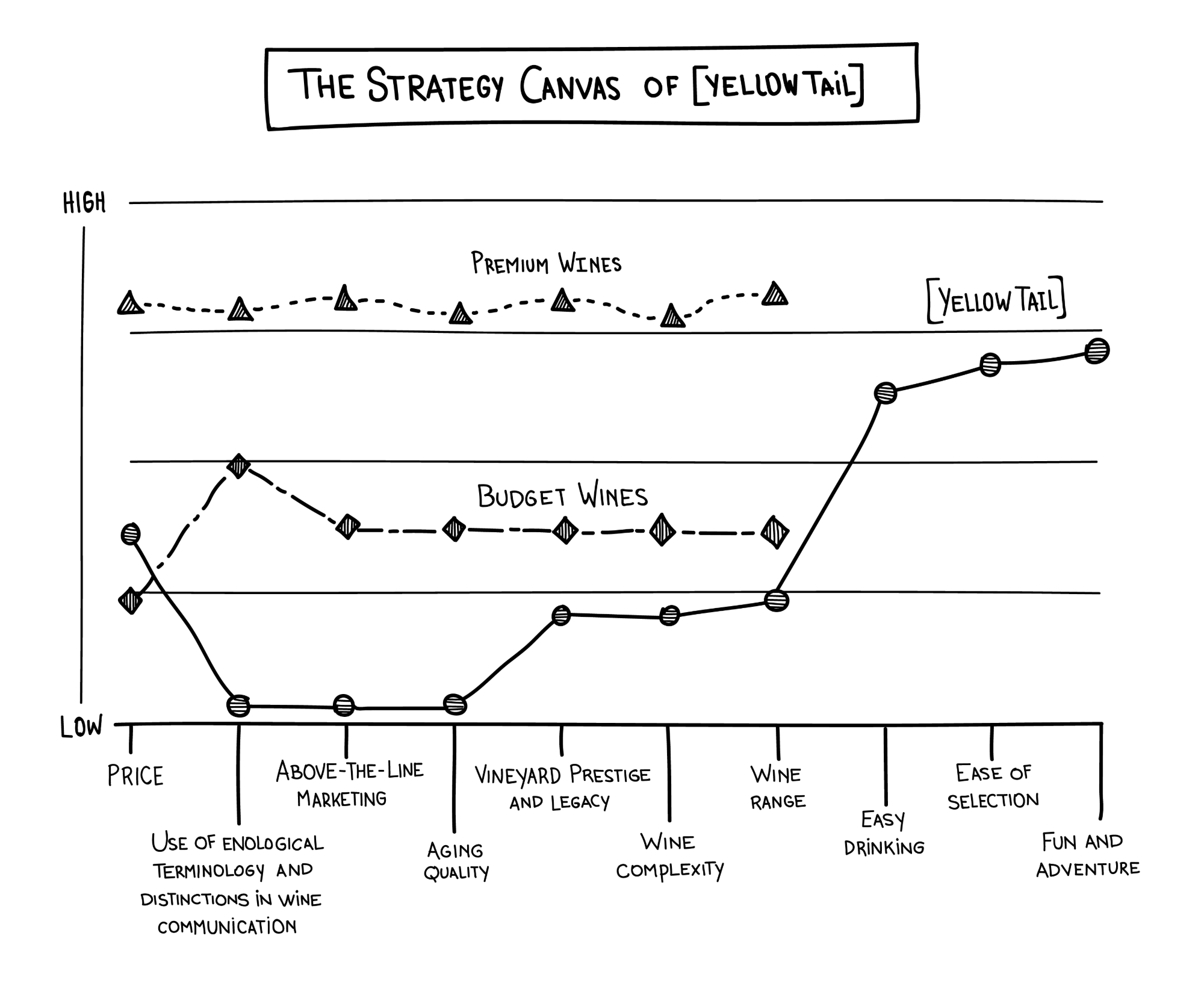
The Strategy Canvas of [yellow tail]. Adapted from Blue Ocean Strategy by W. Chan Kim and Renée Mauborgne.
Banks invented the drive up teller in 1928. Restaurants didn’t adopt the drive through until 1947, and McDonald’s didn’t add one until 1975. Think of all the revenue the fast food industry missed by waiting.
The Four Actions Framework
Eliminate: which factors does your industry take for granted that should be eliminated?
Reduce: which factors should be reduced well below the industry standard?
Raise: which factors should be raised well above the industry standard?
Create: which new factors should be created that the industry has never offered?
[yellow tail] went after non customers
The most important factor on the value curve is what customers want, and what possible non customers want. Converting non customers is sometimes easier, and the market can be bigger than your competitors’ customer base.
Casella Wines felt the wine market was saturated, competing on factors that were complex and seemingly arbitrary. So they looked at the much larger market of beer and cocktail drinkers and asked what it would take to get them drinking wine. Easy drinking, ease of selection, and fun and adventure went onto the value curve. They converted huge numbers of people in a bigger market, and the simpler product lowered their overhead too.
Cirque du Soleil dropped the animals
My favorite case study in the book. Cirque du Soleil’s direct competition was Ringling Brothers and the other three ring circuses. Instead of competing on what Ringling had built since 1884, Cirque started with the first question and eliminated the animals. Gymnasts became the stars, and they’re far easier to source and maintain than tigers.
Then they raised the venue to a comfortable theatre setting and created themes and artistic direction. That pulled in non customers who might otherwise go to the philharmonic or entertain clients at a sports game, and it justified ticket prices from $60 to $200 and up. Ringling Brothers closed after 146 years in business.
Every time I’ve built a new value curve with the Four Actions Framework, I’ve walked away with at least one differentiator worth testing with prospects. It usually leads to more useful insights too.
Where owners get it wrong
They only study their direct competitors. The bigger opening is usually in the alternatives prospects choose instead, and in the people who don’t buy from anyone in your industry yet.
What you walk away with
A new value curve for your offer, and at least one differentiator worth testing with prospects.
Related frameworks
A better offer still needs reps who can sell it.
The Sales Team MRI shows whether your team can carry a new offer to market. Free for $2M to $20M businesses.